Does Your Hocking Hills Cabin Include Firewood? Check Before You Arrive
A fireplace or fire pit in the listing does not automatically mean wood is waiting for you. Use this pre-arrival checklist to learn what is included, what you are allowed to burn, and whether you need a local delivery.
Quick answer
Treat “fire pit,” “wood-burning fireplace,” and “firewood included” as three separate amenities. Confirm the fire feature, confirm that guests may use it, then confirm what fuel is actually provided and how much.
The listing photo answers almost nothing about the wood supply
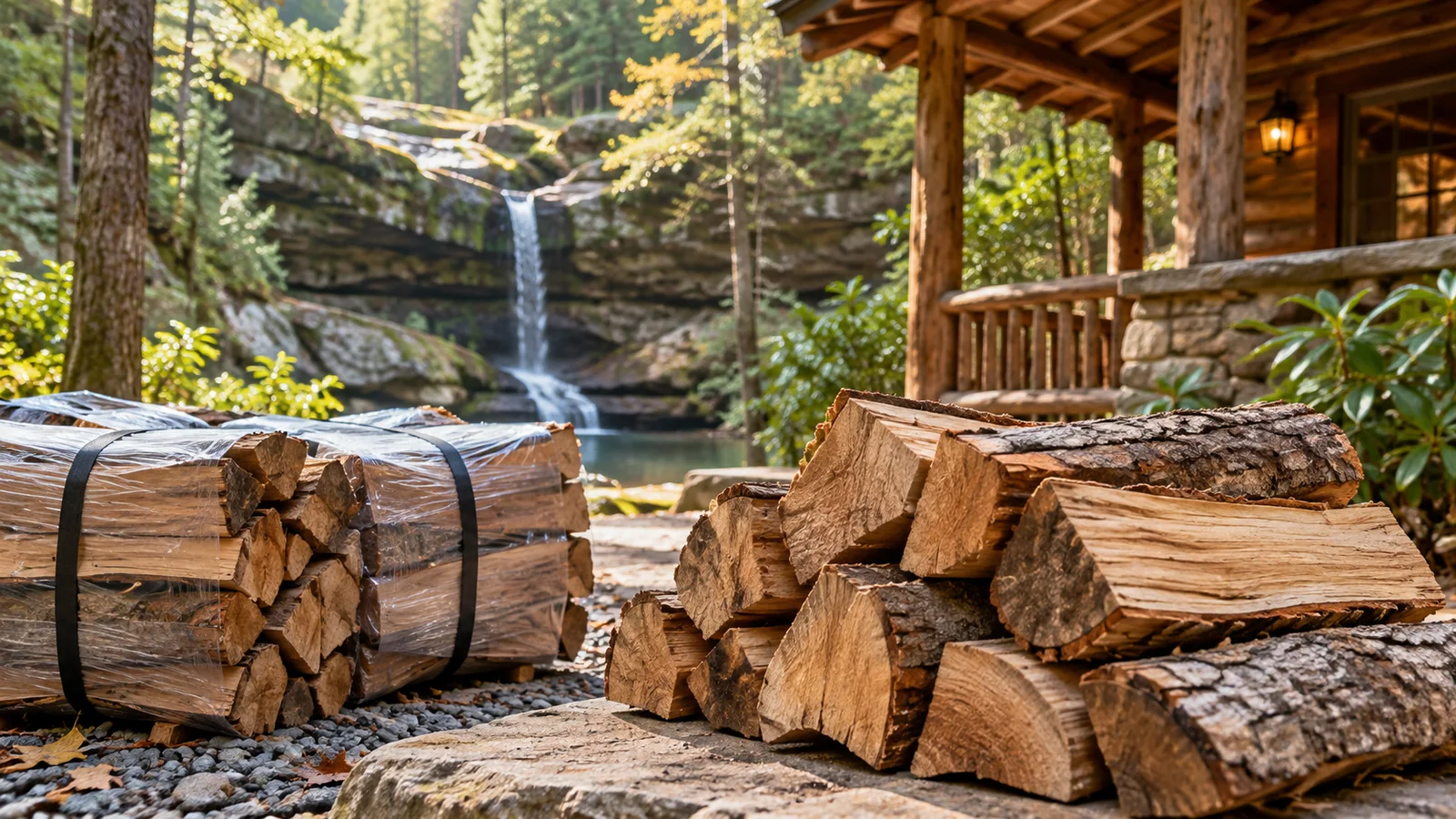
A Hocking Hills cabin can photograph beautifully around a stone hearth or an outdoor fire ring and still leave the fuel entirely to the guest. The photo tells you that a fire feature exists. It does not tell you whether the indoor fireplace burns wood, whether the outdoor ring is currently available, whether the host supplies a starter bundle, or whether additional wood is sold on site.
That distinction matters most on arrival night. Travelers often reach the region after dinner, after a grocery stop, or after dark on rural roads. Discovering at 9:00 p.m. that the “fireplace cabin” has gas logs, or that the outdoor ring has no wood beside it, turns a relaxing amenity into an errand.
The fix is simple: make firewood one of the pre-arrival questions, just like the door code and check-in time. Five minutes of messaging can tell you whether you need to do anything at all.
The eight questions that solve the problem before the trip
Ask the host or property manager in the same message thread you use for check-in details. Keep the questions specific enough that the answer cannot be mistaken for a generic “yes, we have a fire pit.”
- Is the indoor fireplace wood-burning, gas, or electric?
- Are guests currently allowed to use the indoor fireplace?
- Is there an outdoor fire ring, and is it available during my stay?
- Is any firewood included with the rental rate?
- If wood is included, approximately how much is waiting at check-in?
- Is the included wood intended for the indoor fireplace, the outdoor fire ring, or both?
- Can I purchase additional wood from the host or property manager?
- If not, may a local supplier deliver firewood before or during my stay?
“Included” can mean very different things
One cabin may include an armload of wood as a welcome amenity. Another may have a full rack beside the fire ring. A third may provide the first bundle and sell additional bundles. A fourth may include unlimited outdoor wood but require host-supplied wood for the indoor fireplace.
That is why the useful question is not merely “Is firewood included?” Ask what the included supply looks like in practical terms. If your group expects a four-hour fire on both Friday and Saturday night, a small starter stack is different from a weekend supply.
You do not need a perfect cubic-foot calculation. You only need enough information to decide whether the included amount matches your plans.
A simple weekend-use planning table
| Trip plan | What to confirm | Common mistake |
|---|---|---|
| One short outdoor fire | Whether the starter amount is enough for one evening | Buying a large weekend supply you will not use |
| Two long outdoor evenings | Whether the included rack is a starter or the full guest supply | Using most of the wood Friday night |
| Indoor fireplace only | Wood-burning appliance, guest permission, approved fuel and split size | Ordering wood for a gas or electric fireplace |
| Indoor + outdoor | Whether the same wood is allowed in both places | Assuming the indoor host stack can be moved outside |
| Late arrival | Wood availability before stores close; delivery or host-supplied backup | Waiting until check-in to discover there is no wood |
Indoor and outdoor firewood may be different orders
Outdoor rings are physically forgiving. They can usually accept larger splits, and you can stage the main wood supply nearby in an approved outdoor rack. Indoor fireplaces and stoves are different. The firebox may be smaller, the host may restrict outside wood, and the property may have specific instructions for the damper, screen, ash bucket, or log size.
If a cabin has both, tell the host or supplier that you plan to use both. That prevents the classic mistake of buying large outdoor splits and discovering they are awkward or prohibited indoors.
If the listing says gas fireplace, gas logs, or electric fireplace, do not order indoor firewood for that appliance. You may still want wood for the outdoor ring.
Late check-in makes certainty more valuable
A traveler arriving at 4:00 p.m. can improvise. A traveler arriving at 9:30 p.m. in rain with children, groceries, and a weak cell signal has far fewer good options. For late arrivals, solve the wood question earlier than you think you need to.
If delivery is permitted, confirm the full cabin address, cabin name if the property uses one, gate or access procedure, and the approved drop point. If the host sells wood, ask how payment works and where the extra supply is located. If retail bundles are your backup plan, buy them before you leave the last larger town on your route rather than assuming something will be open near the cabin.
What to inspect when you arrive
Even when the host says wood is included, take thirty seconds to look at the setup before nightfall. Identify the approved fire area. Make sure the stacked wood is actually the guest supply rather than a decorative or owner reserve pile. Check whether kindling or fire starters are provided. Locate the host's fire instructions and the method for extinguishing the fire.
If the wood is exposed and has clearly been soaked by rain, contact the host or supplier instead of trying to compensate with accelerants or burning inappropriate materials. A wet pile is a service problem, not a reason to improvise unsafely.
The easiest arrival-night system
The low-friction version of a Hocking Hills cabin weekend is boring in the best possible way: you know what fire feature you have, you know what wood is included, and any additional supply is already arranged before you unload the car.
That removes one decision from the trip and lets the fire stay what it was supposed to be: a cabin amenity, not a logistics problem.
What this means for a typical two-night cabin stay
Think through the trip in sequence: arrival, first-night fire, daytime plans, second-night fire, and checkout. The firewood decision is easiest before the first step. Once the group is settled, nobody wants to leave a warm cabin to solve a supply problem that could have been handled from the car.
That is why the practical questions in this guide are intentionally repetitive around type of fire, quantity, access, dryness, and property rules. Those five variables explain most firewood surprises without requiring a traveler to become an expert on wood species or combustion.
If you would be annoyed to discover the answer after dark, ask the question before check-in.
Three real-world cabin scenarios
Scenario 1: the couple who wants one fire after hiking
You are checking in at 4:00 p.m., cooking dinner at the cabin, and want a two-hour outdoor fire before bed. If the host confirms a modest included stack, you may not need to buy anything. Your job is simply to verify that the wood is intended for guests and is dry enough to use. Buying a large delivered quantity “just in case” creates leftover wood and extra handling.
Scenario 2: the group that wants the fire to run all evening
Eight adults plan to sit outside from dinner until midnight on Friday and Saturday. That is a different consumption pattern. The group is likely to build a larger fire, keep it active longer, and add wood more frequently. A small welcome bundle is unlikely to function as a complete weekend plan. Ask the host what is included, then arrange enough local wood before arrival rather than sending one person out during the evening.
Scenario 3: the winter cabin with an indoor hearth
The listing shows a dramatic fireplace, but the priority is not quantity. First verify that the unit is actually wood-burning and open for guest use. Then ask whether the host requires provided wood. An indoor fire may consume less than a large outdoor gathering, but the compatibility rules are stricter.
Rain changes the value of the included stack
“Firewood included” is less useful if the stack is uncovered and saturated. Hocking Hills trips often include wet shoulder-season weather, and a small rack can take on rain even when the cabin itself is perfectly comfortable. If fire is an important part of the trip, ask whether the guest supply is under cover. For pre-arrival delivery, use a host-approved roofed rack or covered location rather than a random open spot beside the driveway.
Do not assume visibly wet wood is ruined forever, but do not build the evening around it either. A dry backup supply, kindling, and a little time solve the problem more reliably than trying to force wet wood to burn.
Coordinate the answer with the whole group
Cabin trips often fail at the handoff. One person booked the rental, another arrives first, a third buys groceries, and nobody knows who was told that firewood is stored behind the shed. Put the wood instructions in the same shared note as the address, door code, Wi-Fi information, and check-in time. If someone arranged a delivery, include the delivery confirmation and photo.
This also prevents duplicate purchases. Two cars independently buying “a few bundles” on the way in can leave the group with far more wood than the property wants stored.
What to do with leftover firewood
Do not automatically load leftover loose wood into the car for the next destination. Firewood movement can be regulated under invasive-pest quarantines, and the simplest traveler habit is to leave wood where it was purchased and intended to be burned unless the owner directs otherwise. If the host supplied the wood, it belongs to the property. If you purchased a local delivery, ask whether unused wood should remain in the approved rack for the property.
The goal is not to squeeze every last dollar out of the stack. The goal is to avoid moving wood unnecessarily and to leave the rental exactly as the host expects.
Firewood should be confirmed with the same seriousness as other trip essentials
You would not assume a cabin has pet permission, an EV charger, or accessible entry merely because a photo hints at it. Treat firewood the same way. The listing photo is inspiration; the host's current answer is operational truth.
Once you adopt that habit, the question becomes routine rather than a source of uncertainty: verify, fill the gap locally if needed, and move on to the rest of the trip.
Confirm the cabin allows outside delivery, then arrange local firewood using the exact property address, stay dates and approved drop point.
Message template to send your host
Hi — we are planning to use the fire feature during our stay. Could you confirm whether the indoor fireplace is wood-burning, whether guests may use it, whether firewood is included, approximately how much is provided, and whether local delivery is allowed if we need more? If delivery is allowed, where should it be left?
What to put in your trip notes
Save the answer with the door code and check-in directions. Write down whether the wood is included, where it is stored, and how to get more. This sounds excessive until the group splits into two cars and the person who received the host message is not the first person to arrive.
Firewood trip-planning glossary
| Term | Plain-English meaning for a cabin guest |
|---|---|
| Seasoned firewood | Wood that has been dried for burning rather than freshly cut green wood. |
| Kindling | Small dry material used to establish the first flame before larger splits are added. |
| Split | A piece of firewood that has been divided from a larger round. |
| Firebox | The chamber inside a fireplace or stove where fuel burns. |
| Damper | A control in some fireplaces that affects the exhaust path and draft. |
| Par level | For owners, the target inventory level to have ready for the next guest. |
One final check before travel day
Read the host's most recent arrival message rather than relying on the listing you booked months earlier. Property rules, access instructions, available amenities, and seasonal conditions can change. If the fire is important to the weekend, confirm it the same way you confirm the door code: close enough to the trip that the answer is current.
Frequently asked questions
Do most Hocking Hills cabins include firewood?
Policies vary by property. A fire pit or wood-burning fireplace does not guarantee that the rental rate includes firewood.
Can a local supplier deliver before I check in?
Often, if the property allows unattended delivery and the supplier has the exact address, access instructions, and an approved drop location.
How much firewood should I expect if the host says a starter bundle is included?
There is no universal quantity. Ask the host to describe the amount or send a photo so you can decide whether you need more.
Can I burn delivered wood in the indoor fireplace?
Only if the fireplace is wood-burning, guest use is permitted, and the property allows outside locally sourced wood.
What if the fireplace is gas or electric?
Do not place firewood in it. Use the appliance only as the host or manufacturer directs.
Information reviewed September 26, 2026. Property rules, weather conditions, business availability, and pest-quarantine boundaries can change. For legal firewood-movement questions, use current Ohio Department of Agriculture and Ohio Administrative Code sources.