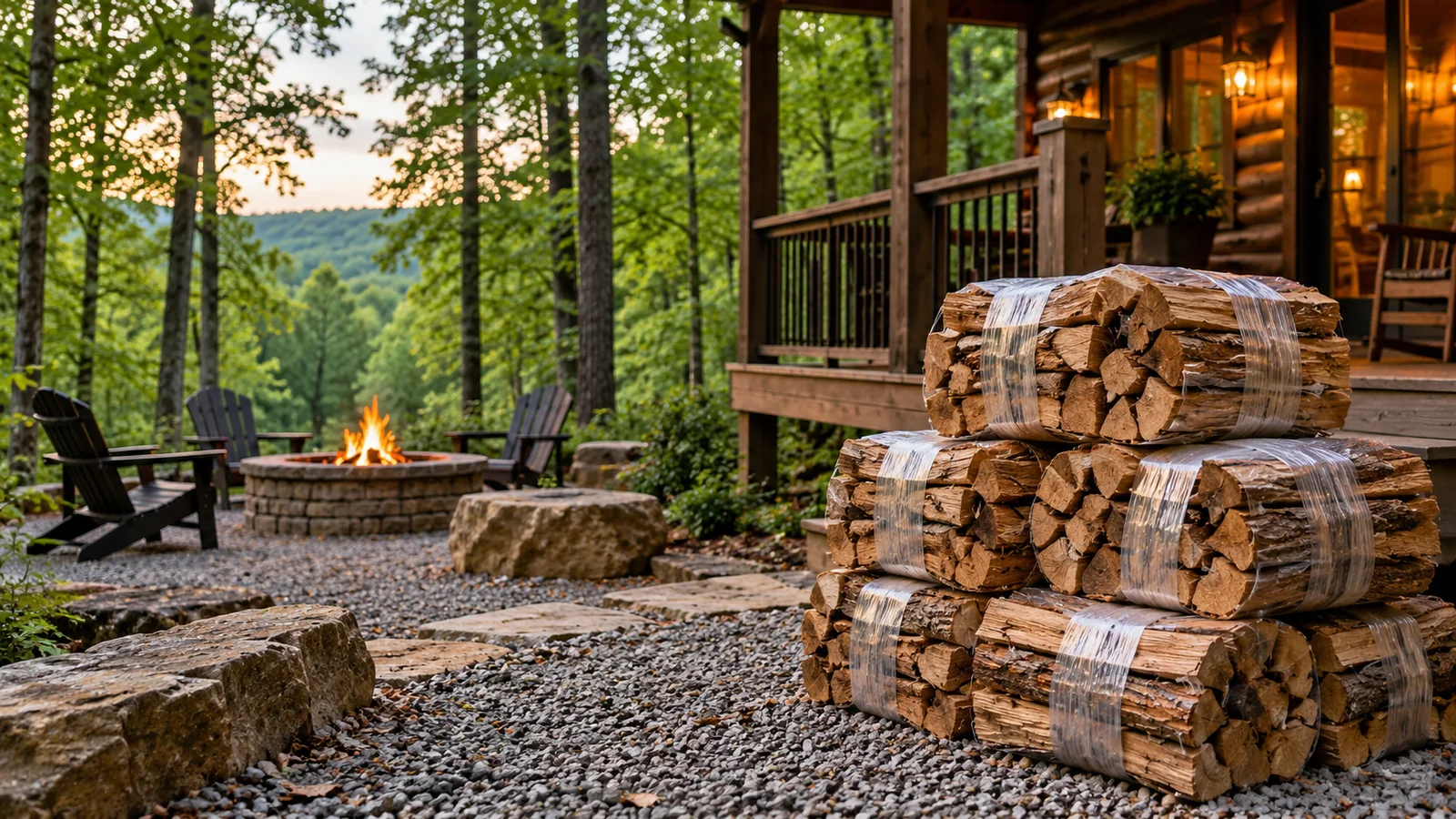
Bundles, Totes, Face Cords: Firewood Quantities Hocking Hills Guests Actually Need to Understand
Travelers encounter firewood sold by the bundle, tote, rack, face cord, and full cord. Those terms do not all measure the same thing, so compare the physical quantity before you compare the price.
Quick answer
A full cord is a defined stacked volume of 128 cubic feet. A “face cord” is not a complete volume unless the log depth is stated. Bundles and totes are container-based retail units, so ask their actual dimensions or capacity before comparing sellers.
Why this gets confusing fast
Most people buy firewood only a few times a year, often while traveling. Sellers, by contrast, use local units every day. That creates a vocabulary gap: the seller says “tote,” “rack,” or “face cord” and assumes the buyer can visualize it.
The solution is not memorizing every regional nickname. It is converting the offer back into something physical: container size, stacked dimensions, or a clear photo.
The units at a glance
| Term | What it means | Traveler takeaway |
|---|---|---|
| Full cord | 128 cubic feet of stacked firewood | Standard benchmark; usually far more than a weekend guest needs |
| Face cord | A 4-by-8-foot visible face with variable depth | Ask log length/depth before comparing price |
| Bundle | Small wrapped or strapped retail unit; size varies | Convenient for one or two fires, poor comparison unit without dimensions |
| Tote | Container-based quantity; tote size varies | Ask gallon capacity or dimensions and whether wood is stacked or loose |
| Rack/bin/stack | Seller-defined physical unit | Ask for dimensions or a photo |
Full cord: the standardized benchmark
A full cord is 128 cubic feet of stacked firewood, traditionally visualized as a stack four feet high, four feet deep, and eight feet long. Actual individual pieces can vary, but the stacked volume is the benchmark.
That is a large amount of firewood for a short vacation. Weekend cabin guests generally encounter much smaller retail units. The full cord is still useful because it gives you a standardized reference point when you read other firewood terminology.
Face cord: incomplete unless the depth is stated
A face cord commonly describes a single row four feet high and eight feet long. The missing dimension is the depth of the row, which is determined by the log length. A row of 16-inch logs and a row of 24-inch logs have the same visible face but very different volumes.
That is why “face cord” should trigger one follow-up question: how long are the pieces, or how deep is the stack? Without the third dimension, you cannot make a reliable volume comparison.
Bundles: familiar, portable, and expensive to scale
A retail bundle is intentionally convenient. It fits in a trunk, requires no measuring, and solves a one-fire emergency. But “bundle” itself is not a universal volume. Piece count, split size, and wrap dimensions vary.
Bundles make sense when you need a small amount or are already stopping at the store. If you need enough for several long evenings, repeatedly buying bundles can become inconvenient and can make the total price hard to compare with a larger delivered unit.
Totes: ask the container size
A tote is a practical traveler unit because it describes a container you can see and move. But tote sizes vary. A small storage tote, a 27-gallon tote, and a large bulk tote are obviously not interchangeable.
If a seller quotes a price “per tote,” ask the tote capacity or dimensions and whether the wood is loosely filled or stacked. The answer lets you compare one tote seller to another without pretending that the word itself is standardized.
Racks, bins, and “stacks”
These are useful sales units only when the physical dimensions are clear. A rack can be a compact porch rack or an eight-foot storage rack. A “stack” can mean anything from one neat row to a truckload.
For cabin guests, a photo is often enough. Ask the seller to show the typical delivered unit beside a familiar object or provide the rack dimensions. You are trying to answer a practical question: will this cover the fires we plan to have?
How to compare two offers without doing firewood algebra
Compare five things: the physical amount, dryness, delivery charge, distance or pickup time, and whether the wood is approved for your intended fire feature. A slightly larger quantity of wet wood is not automatically a better deal. A cheaper roadside stack that forces a forty-minute round trip after dark may not be cheaper in any meaningful vacation sense.
For a two- or three-night trip, convenience and certainty often matter as much as cents per cubic foot.
A guest-friendly quantity conversation
Tell the seller the number of nights and how you expect to burn: outdoor ring for three hours each evening, one indoor fire, or a large group planning to sit outside most of the night. Then ask which of the seller's actual units fits that use.
This avoids the false precision of saying “I need 26 logs,” because pieces vary dramatically in size and burn time.
What to photograph when you receive a delivery
If you want to learn your own burn rate for future trips, take one photo of the delivered quantity before the first fire and another of what remains at checkout. Note the hours you burned.
After one weekend, you will have a better personal benchmark than any generic “two-night quantity” chart can give you.
What this means for a typical two-night cabin stay
Think through the trip in sequence: arrival, first-night fire, daytime plans, second-night fire, and checkout. The firewood decision is easiest before the first step. Once the group is settled, nobody wants to leave a warm cabin to solve a supply problem that could have been handled from the car.
That is why the practical questions in this guide are intentionally repetitive around type of fire, quantity, access, dryness, and property rules. Those five variables explain most firewood surprises without requiring a traveler to become an expert on wood species or combustion.
If you would be annoyed to discover the answer after dark, ask the question before check-in.
Use dimensions to convert seller language into something comparable
If a rack is 4 feet wide, 3 feet high, and 16 inches deep, you can calculate its approximate stacked volume. If a tote is labeled in gallons, you can at least compare it with another tote of a known capacity. The number will not perfectly predict burn time because stacking density and split size vary, but it is far better than comparing words such as “large bundle” and “big tote.”
For a one-time cabin purchase, you do not need to perform exact conversions. Ask for dimensions or a photo. For repeat trips or a property-management operation, recording the dimensions becomes useful because you can relate one delivery unit to actual consumption.
Why weight is not a perfect shortcut
Wood weight changes dramatically with moisture content and species. A heavier load can mean denser wood, but it can also mean wetter wood. That makes pounds a poor single-number comparison for a traveler unless the seller is using a consistent product and moisture standard.
Volume plus dryness is generally easier to understand: how much space does the wood occupy, and is it seasoned enough to burn well?
Photographs are surprisingly powerful quantity tools
Ask for a typical photo of the seller's bundle, tote, rack, or delivery. If possible, the photo should include the container or a familiar object for scale. Save it. After the trip, photograph what remains.
Over time, you can build your own personal reference: “That tote lasted two evenings for four adults” or “We used two retail bundles during one short outdoor fire.” Personal burn history is more useful than generic piece counts.
Do not buy a cord-scale quantity for a weekend simply because the unit price looks better
Bulk firewood gets cheaper per unit of volume, but storage and leftover handling matter. A cabin guest usually cannot decide where a large leftover stack should live. The property owner may not want it, and transporting it onward can raise pest-quarantine questions.
Buy the amount that fits the trip and the host-approved storage space. Vacation purchases should optimize for usefulness, not warehouse economics.
A comparison worksheet for two sellers
| Question | Seller A | Seller B |
|---|---|---|
| Unit dimensions/capacity | ||
| Seasoned/dry? | ||
| Delivered or pickup? | ||
| Delivery fee | ||
| Indoor-compatible if needed? | ||
| Arrival timing | ||
| Total price |
That worksheet captures the practical variables a cabin guest actually cares about.
How storage space should affect the quantity you buy
Cabin guests do not own the property, so they cannot simply choose a convenient corner for excess wood. Before buying a large quantity, identify the approved storage area. A compact covered rack may hold only a modest amount. Overbuying can leave the group with wood stacked on the ground, exposed to rain, or placed where the owner does not want it.
For a large group, ask whether the supplier can split a delivery between an immediate-use rack and an approved reserve location. For a short stay, a smaller quantity that fits the property cleanly is often a better purchase than a bulk unit with a lower theoretical price per cubic foot.
This is another reason container-based units can be useful to travelers: you can visualize whether two totes, four bundles, or one rack will physically fit where the cabin expects firewood to live.
When price-per-unit comparisons stop being useful
Cabin guests are not buying winter heating fuel for a house. The cheapest theoretical cubic foot can be the wrong purchase if it creates a detour, exceeds the property's storage space, arrives after the planned fire, or cannot be used in the indoor appliance. Once the quantity is large enough for the trip, convenience and fit often matter more than squeezing the last few cents out of the volume calculation.
Use standardized measurements to avoid being confused, not to turn a weekend into a procurement exercise.
Confirm the cabin allows outside delivery, then arrange local firewood using the exact property address, stay dates and approved drop point.
Why log count is a bad comparison metric
Ten large splits can contain more wood than twenty small splits. Species and moisture also change weight. That is why sellers and buyers get into trouble when a photo is described only as “about 25 pieces.” Container volume or stacked dimensions create a much better comparison.
Build your own reference after one trip
Note the seller's unit, photograph it, record roughly how many hours you burned, and note what remained. The next time you visit Hocking Hills, you can say “last trip we used about three-quarters of this size delivery,” which is far more actionable than a generic internet estimate.
Firewood trip-planning glossary
| Term | Plain-English meaning for a cabin guest |
|---|---|
| Seasoned firewood | Wood that has been dried for burning rather than freshly cut green wood. |
| Kindling | Small dry material used to establish the first flame before larger splits are added. |
| Split | A piece of firewood that has been divided from a larger round. |
| Firebox | The chamber inside a fireplace or stove where fuel burns. |
| Damper | A control in some fireplaces that affects the exhaust path and draft. |
| Par level | For owners, the target inventory level to have ready for the next guest. |
One final check before travel day
Read the host's most recent arrival message rather than relying on the listing you booked months earlier. Property rules, access instructions, available amenities, and seasonal conditions can change. If the fire is important to the weekend, confirm it the same way you confirm the door code: close enough to the trip that the answer is current.
Frequently asked questions
What is a full cord of firewood?
A full cord is 128 cubic feet of stacked firewood.
Is a face cord the same everywhere?
Not necessarily. The visible face may be 4 by 8 feet, but the depth depends on log length, so ask for the third dimension.
Is a bundle a standardized amount?
No. Bundle dimensions and piece counts vary by retailer.
Is a tote standardized?
No. Ask for the tote capacity or dimensions and how it is filled.
What is the easiest way for a cabin guest to compare quantities?
Ask for a photo or physical dimensions, then compare that quantity with your planned number and duration of fires.
Information reviewed September 26, 2026. Property rules, weather conditions, business availability, and pest-quarantine boundaries can change. For legal firewood-movement questions, use current Ohio Department of Agriculture and Ohio Administrative Code sources.